


Evidence-based practice training
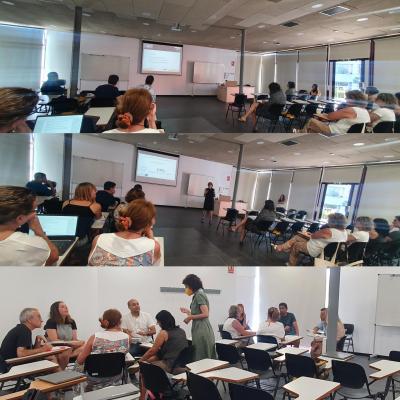
On 11st July 2022, the last training session on Educational Practices Informed by Evidence was held at UAB.
On July 11, 2022, the fourth and last training session on Educational Practices Informed by Evidence was held within the framework of the training program of the EIPSI project with the participating Catalan centers. On this occasion, and unlike the other three past training sessions, the training was carried out in person at the Faculty of Education of the Autonomous University of Barcelona.
The training session began with the conference "Educational innovation and research: evidence-based practices", given by Daniel Pattier, assistant professor at the Complutense University of Madrid. Next, two workshops were held with the aim of promoting the participation and dialogue of the assistant professors:
- 'From expert evidence to multisectoral triangulation: The construction of complex realities in the FakeNews era', by Neus Lorenzo and Francesca Burriel.
- 'From research to practice', by the CRiEDO-UAB team.
The last part of the session was devoted to the presentation of the activities planned for the 2022/2023 academic year
The project “EIPSI - Evidence-informed Practice for School Inclusion” aims to design, prototype and test innovative solutions for teachers and stakeholders (such as educational advisors, inspectors, public administrators, delegates) to improve the equity and inclusion of students through the use of Evidence-Based Practices.
Addressing school inclusion requires a holistic and interdisciplinary approach, and our consortium is made up of professionals from different areas of knowledge and experience: research, teaching, policy formulation, teacher training, coaching, school development, school inspection, psychopedagogical and educational advice from five different countries and three types of institutions: higher education, public administration and professional association.
To address these priorities, the project proposes a holistic approach, which includes a 360º intervention plan that addresses three pillars: (1) the development of teachers' capacities; 2) school development; 3) networking with stakeholders and raising awareness.
Visit the official website of the project:
Share on social media: