

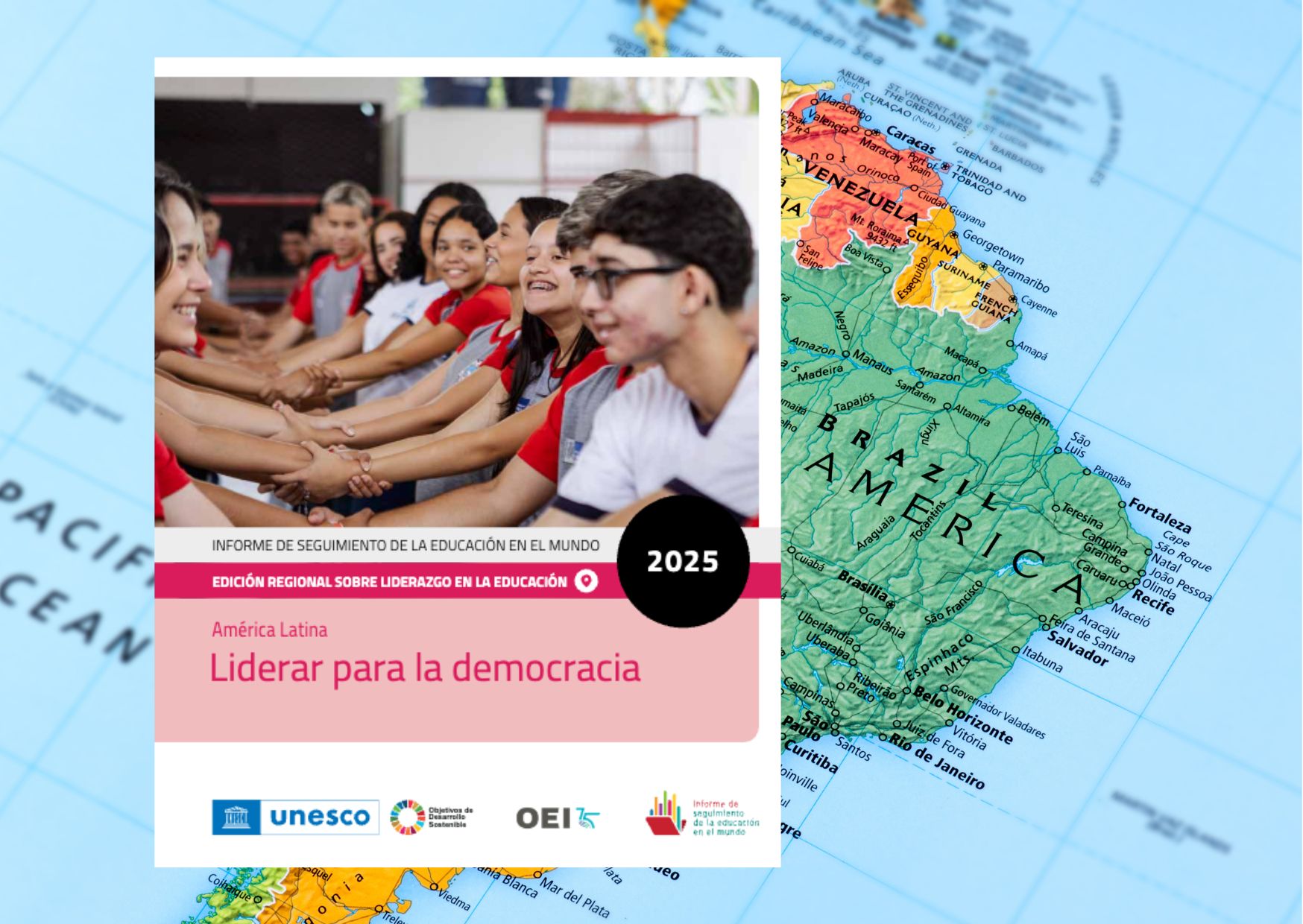
The Global Education Monitoring Report 2025: Regional Edition on Leadership in Education in Latin America. Leading for Democracy has been published. This new contribution from UNESCO’s GEM (Global Education Monitoring) Report team examines the role of educational leadership in building more participatory, inclusive, and democratic school communities.
The GEM Report is the international mechanism responsible for monitoring progress towards the achievement of Sustainable Development Goal 4 (SDG 4), which aims to ensure inclusive, equitable, and quality education for all. As established by the Incheon Declaration and the Education 2030 Framework for Action, the report tracks the implementation of national and international education strategies and contributes to the global monitoring of the Sustainable Development Goals.
This regional edition complements the 2024/25 GEM Report and focuses on distributed leadership practices within Latin American education systems. The report is based on the premise that school leaders cannot and should not be regarded as individual heroes. Given the growing complexity of educational challenges, it advocates for a shared leadership model grounded in collaboration, trust, and collective responsibility among all members of the educational community.
The report highlights that distributed leadership shifts attention from individual actions to the dynamics of social interaction within educational institutions. In this regard, school leadership teams are encouraged to promote the participation of teachers, students, families, and the wider community in decision-making processes, creating more inclusive and innovative environments.
Although the concept of distributed leadership is not explicitly present in many educational policies across the region, the study points out that Latin American educational culture incorporates numerous democratic management practices. These include shared leadership teams, teacher collectives, community councils, and student governments, all of which help strengthen participation and empower the entire school community.
According to the report’s findings, actively involving all educational stakeholders in school governance fosters democratic values and greater shared responsibility for educational improvement. Thus, while distributed leadership and democratic leadership are not synonymous concepts, shared leadership practices can become a key tool for strengthening democracy through education.
The Global Education Monitoring Report is an independent annual publication produced by a team hosted by UNESCO and funded by a group of donors, multilateral organizations, and private foundations. The views expressed in the report are solely those of the authors and do not necessarily reflect the positions of UNESCO or its funding partners.
Access the report here.