


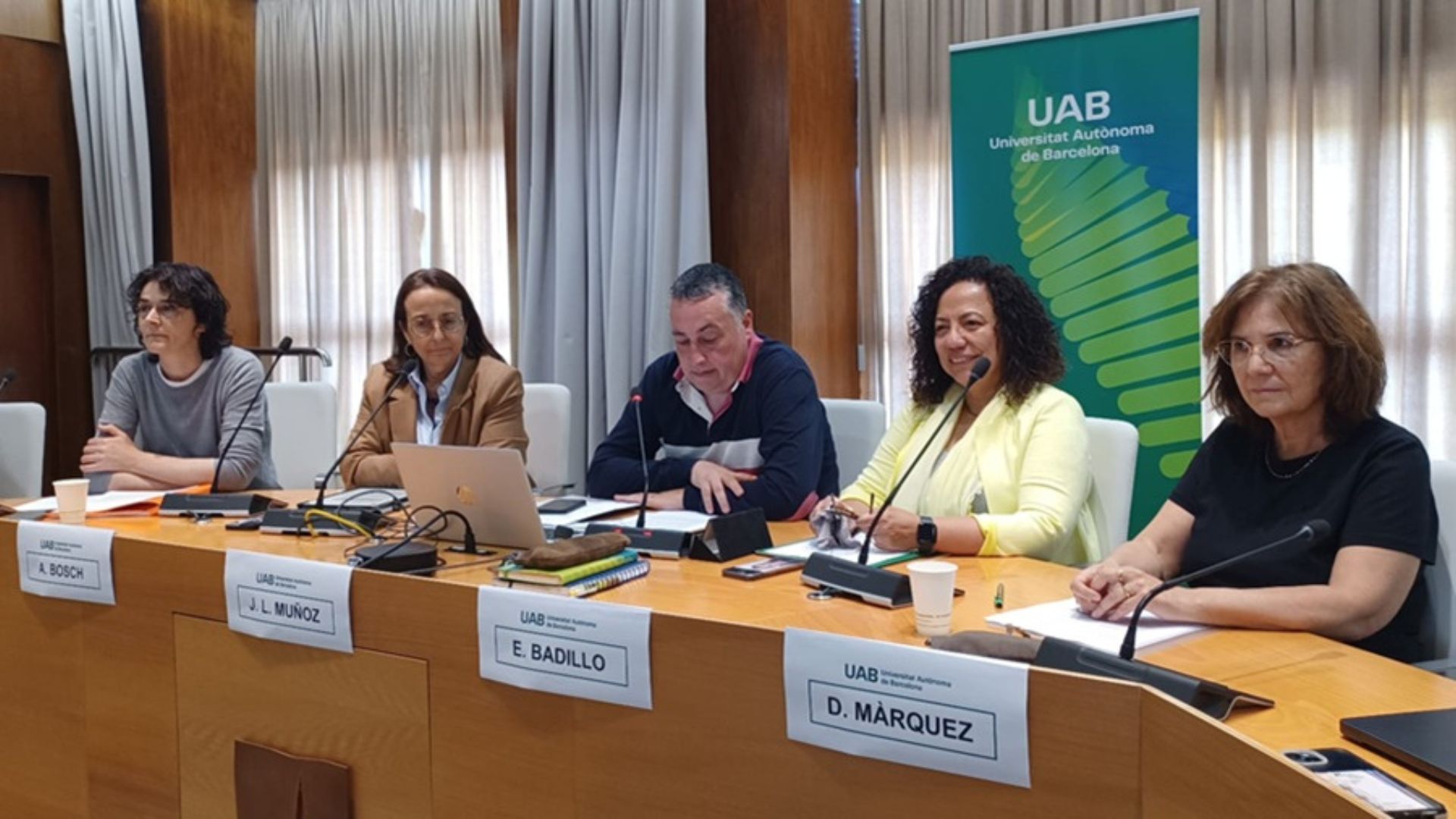
The study was carried out by researchers Dolors Márquez, professor in the Department of Economics and Economic History, and Patricia Olmos, professor in the Department of Applied Pedagogy and member of CRiEDO, with the collaboration of Laia Vila, researcher in the same department and also a CRiEDO member. The study was coordinated by Edelmira Badillo, Director of the Institute of Education Sciences (ICE), together with Vice-Rector José Luís Muñoz, also a member of CRiEDO.
The report, entitled Absenteeism in UAB university classrooms. Why going to class matters, is the first volume in the UAB Teaching Studies Report Series. This series is promoted by the Vice-Rectorate for Teaching and Educational Innovation and coordinated by the Institute of Education Sciences (ICE), with the support of the UAB Social Council.
The study does not focus on occasional absence from class—due to specific reasons such as health, work, or unforeseen circumstances—but rather on the repeated non-attendance of students who are in optimal conditions to attend classes but choose not to do so. The research is based on the participation of 3,045 members of the university community—2,253 students, 732 faculty members, and 60 members of the management teams of teaching centres—and provides a rigorous and plural snapshot of an issue that is a shared concern.
The findings show that absenteeism is a complex and multi-causal phenomenon, resulting from the interaction of various factors. Key factors include personal and health-related conditions—such as emotional well-being—the need to combine studies and work, transportation and campus access difficulties, as well as issues related to motivation and engagement with studies. These are compounded by teaching and organisational aspects such as teaching methodologies, assessment systems, and academic organisation.
In this regard, the study highlights the diversity of students’ circumstances: nearly four out of ten students work while studying, a significant proportion report economic or health difficulties, and the majority depend on public transport to reach the campus, which is often affected by disruptions and service shortcomings. This context significantly conditions class attendance.
With respect to teaching practices, the report notes that although the lecture format remains predominant, a substantial proportion of faculty members already incorporate more active and participatory methodologies. Nevertheless, it underscores the need to continue moving towards approaches that foster greater student engagement and better align with students’ interests and expectations.
The full report can be consulted here.