

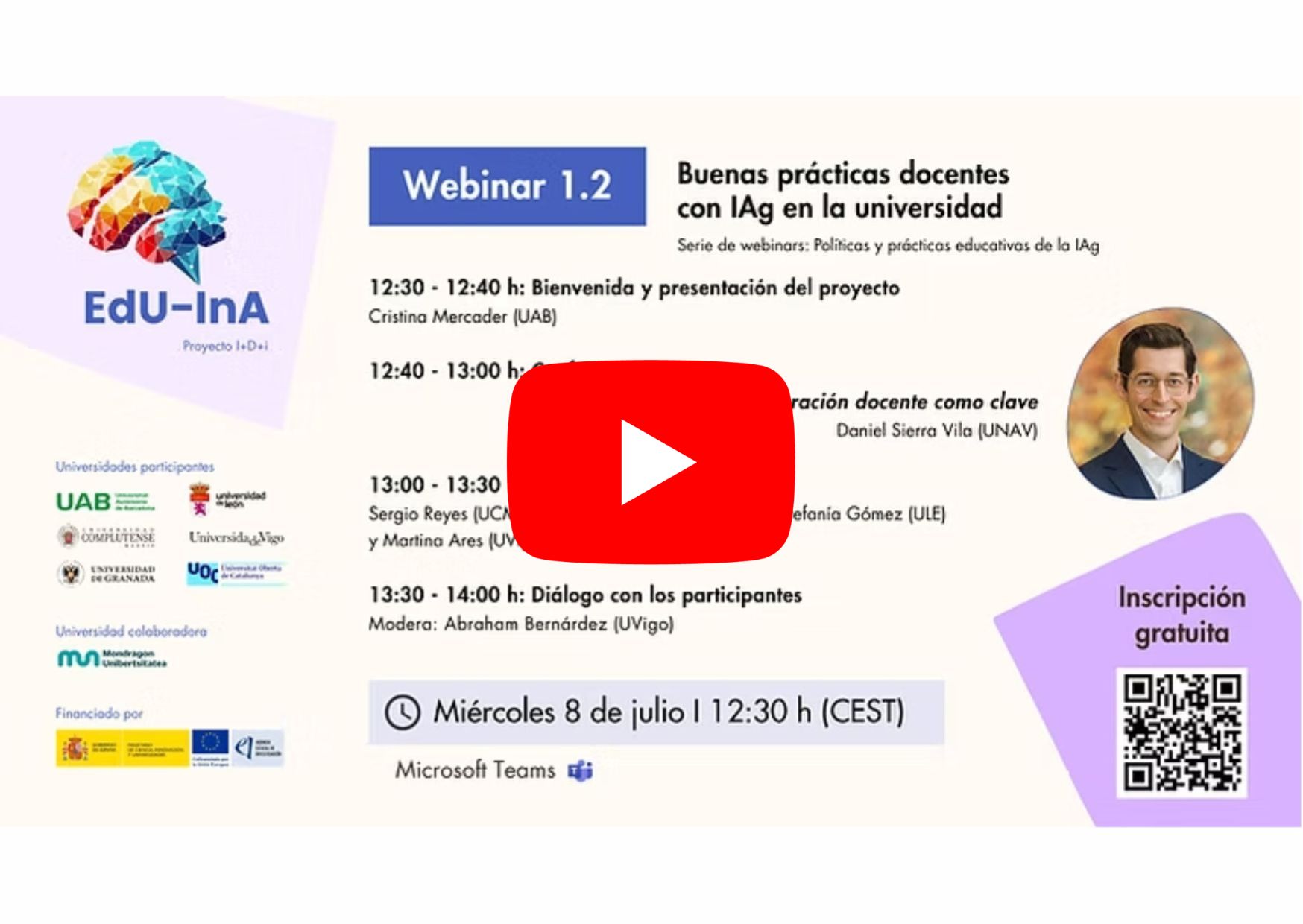
On Wednesday, July 8, 2026, the online seminar “Good Teaching Practices with Generative AI in Higher Education” was held as part of the EdU-InA project.
The session, hosted via Microsoft Teams, brought together faculty members, researchers, and institutional leaders interested in the impact of generative artificial intelligence on higher education. This seminar was the fourth webinar in the dissemination series “Policies and Educational Practices of Generative AI”, which accompanies the development of the project with the aim of sharing progress achieved in each of its specific objectives. On this occasion, the webinar focused on Specific Objective 1.2, dedicated to identifying good practices for the use of generative AI in university teaching across different academic disciplines.
The session began with a presentation of the project by Cristina Mercader, one of the two coordinating researchers of EdU-InA. This was followed by a keynote lecture entitled “Connecting Talent: Teacher Collaboration as a Key Driver”, delivered by Daniel Sierra Vila, a member of the Vice-Rectorate for Teaching and the Teaching Planning and Improvement Service at the University of Navarra.
Daniel Sierra works in the field of planning and implementing teacher training programs, with a particular focus on the integration of generative artificial intelligence and the development of faculty digital competencies. He is also a co-founder of the EurekAI initiative, through which he has contributed to the design of a pedagogical framework and an institutional strategy for the adoption of AI in education.
The session continued with presentations by several members of the research team, who shared findings related to Specific Objective 1.2. The speakers were Sergio Reyes Angona (Complutense University of Madrid), Juan Carlos de la Cruz Campos (University of Granada), Estefanía Gómez Muñoz (University of León), and Martina Ares Ferreirós (University of Vigo).
The seminar concluded with an open discussion moderated by Abraham Bernárdez Gómez (University of Vigo), allowing participants to further explore the topics discussed and share reflections from different institutional contexts.
The EdU-InA project, funded by the Spanish Ministry of Science, Innovation and Universities (PID2023-149069OA-I00), aims to contribute to the integration of generative artificial intelligence in higher education based on scientific evidence, ethics, and equity. Within this framework, the project will continue promoting dissemination activities to share its findings with the academic community.
The full recording is now available to watch here.