


Access to and permanence in university still does not offer, for the moment, the same opportunities to all citizens who are able to undertake higher education. Economic, cultural, social or gender reasons penalise possibilities of personal and social achievement and promotion. The utopia of a more inclusive university continues to be, in this regard, a challenge for these institutions. This contribution, complementary to others already published previously on the subject, includes the most significant contributions presented at the 2014 University and Vulnerable Groups Congress, held in Veracruz (Mexico) on 29 and 30 October 2014. Promoted by the ACCEDES Project, it has been a space to present and debate the results of the same, as well as an opportunity to meet with other significant projects and experiences on the subject. The most notable aspect of this project is the departure it represents from general contributions on inclusive universities and the focus it makes on specific proposals centred on the most vulnerable groups that can be found in universities: indigenous people, women, the disabled, minorities, non-regular students, students from rural areas, migrants and groups with a very low Human Development Index (HDI). It also has a practical orientation, by focusing on strategies, instruments and experiences. In short, it is about supporting the development of a university whose mission and objectives are oriented towards promoting the inclusion of all students and, especially, those who are in a vulnerable situation and who can highlight the capacity or incapacity of the university system to achieve a balance between quality and equity. The ACCEDES project, funded by the European Union, thus contributes to achieving its objectives linked to the development of tools for the organisational development of higher education institutions in the application of actions to improve access, academic excellence and the graduation phase of vulnerable groups. We hope that its content serves the purpose mentioned, contributes to the promotion of inclusion in higher education in Latin America and helps to find a balance between quality and equity in university systems.
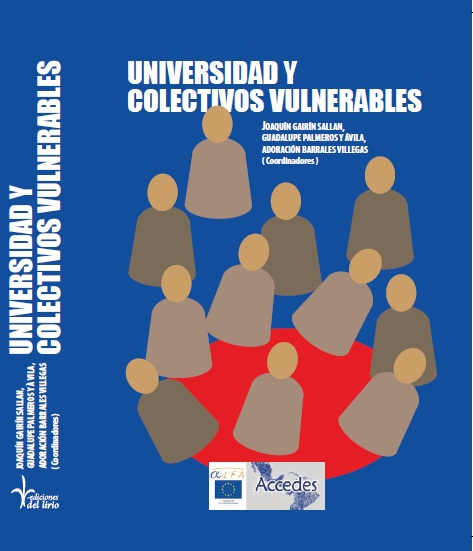
Universidad y colectivos vulnerables
Year of publication: 2014
Authorship: Joaquín Gairín Sallán, Guadalupe Palmeros y Ávila, Adoración Barrales Villegas
Editorial: Ediciones del Lirio
ISBN: 978-607-8371-34-1