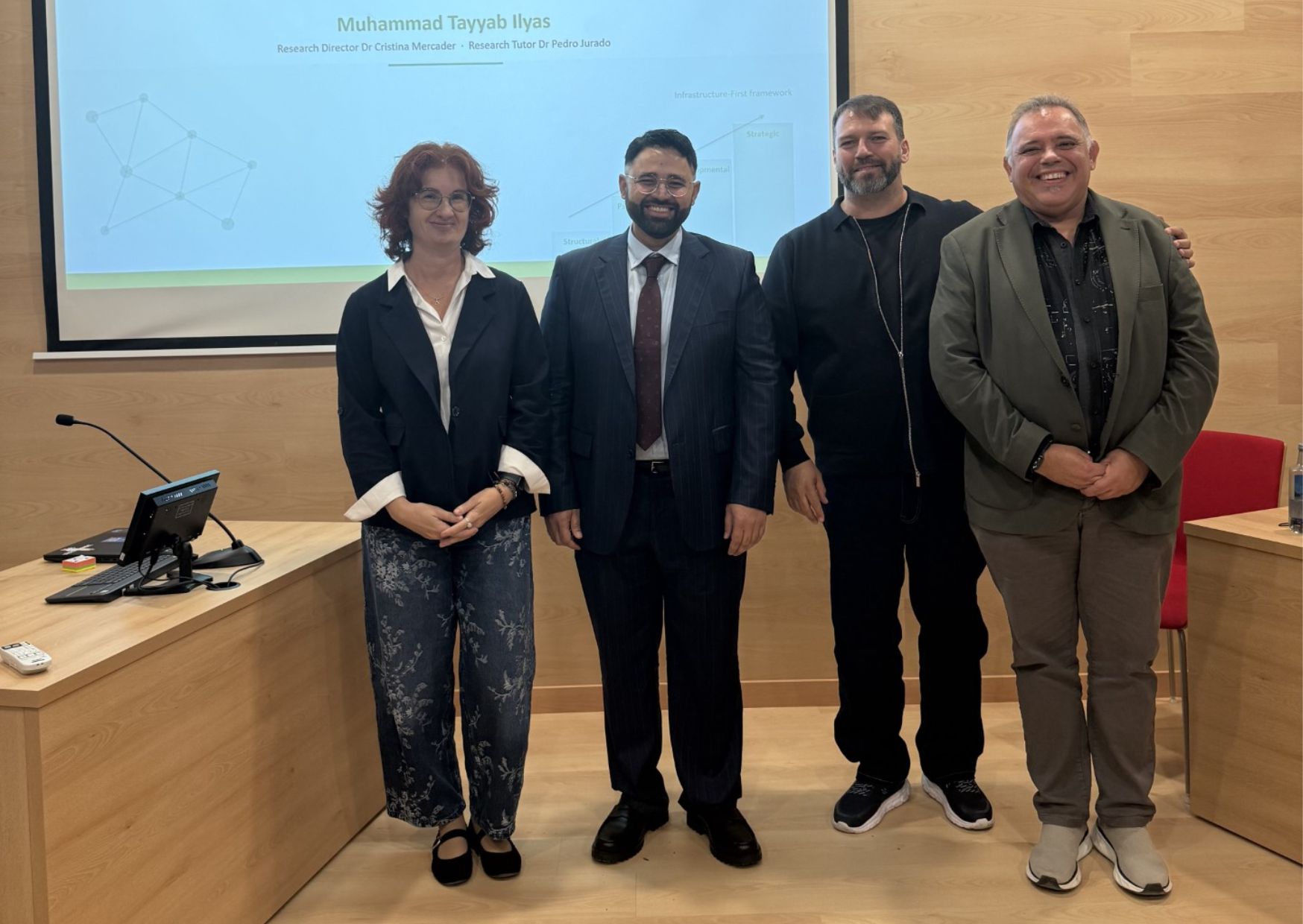
On 22 October 2026, Muhammad Tayyab Ilyas defended his doctoral thesis, entitled Exploring University Teachers’ Pedagogical Digital Competence and Its Relationship with Teaching Practices, in the Board Room of the Faculty of Educational Sciences at the Universitat Autònoma de Barcelona (UAB).
The examination committee was composed of Dr Mireia Usart Rodríguez (Universitat Rovira i Virgili), Dr Antoni Navio Gámez (Universitat Autònoma de Barcelona), and Dr Mario Grande de Prado (Universidad de León). The thesis was supervised by Dr Cristina Mercader.
The research examines how university teachers’ pedagogical digital competence is related to their teaching practices in contexts characterised by structural and technological constraints. Specifically, the study focuses on higher education in Pakistan, where many academics work under conditions for which most existing digital competence frameworks were not originally designed.
Aiming to identify strategies to improve technology integration in higher education and to develop a framework applicable across different institutional contexts, the study was conducted at the University of Gujrat using an explanatory sequential mixed-methods design. The quantitative phase involved a survey of 127 faculty members based on the CheckIn Higher Education questionnaire and the DigCompEdu framework, while the qualitative phase consisted of 32 semi-structured interviews with teachers representing different levels of digital competence.
The findings indicate that 18.9% of participants demonstrated a low level of pedagogical digital competence, 50.4% a medium level, and 30.7% a high level. The weakest areas were Open Education and Assessment, while no significant gender differences were identified. The qualitative analysis highlights the influence of available infrastructure, the importance of peer-support systems, strategies for coping with public technology-related failures, and differing approaches to the adoption of artificial intelligence in teaching.
By integrating the quantitative and qualitative findings, the thesis proposes the Infrastructure-Centered Digital Competence Framework, an innovative model that outlines structural, educational, psychological, and strategic actions to support more effective technology use in higher education. The framework conceptualises digital competence as a socially distributed phenomenon shaped by available infrastructure, providing a complementary perspective to the DigCompEdu and TPACK frameworks and offering particularly relevant guidance for higher education institutions in the Global South.
Access the thesis here.