


Unusual routes of access to the university
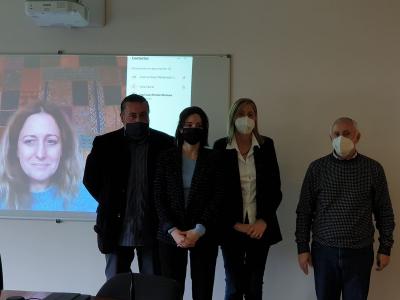
On December 21th, Cristina Pérez Maldonado read her doctoral thesis.
The thesis prepared by Cristina Pérez Maldonado, entitled "Barriers and facilitators perceived by students who enter the university through unusual means", has been directed by Dr. Joaquín Gairín. The thesis was defended before the court formed by Pilar Figuera Gazo (University of Barcelona), acting as President, José Luís Muñoz (Autonomous University of Barcelona), acting as secretary and María Ilida de Meireles Cabral da Rocha (Portuguese Catholic University of Porto) acting as a vowel.
The purpose of this doctoral thesis is to achieve greater clarity in the identification of difficulties in accessing the university for students from non-habitual routes in Catalan public universities. This milestone is developed in two general research objectives: a) analyze the causes that lead students to access the university through unusual routes and b) analyze the barriers and facilitators perceived by students who access university through unusual routes. Finally, she proposed a model to reduce barriers and enhance the identified facilitators.
The research approach is of a mixed nature, interweaving the qualitative and quantitative approaches through the application of instruments from both methods. The selected case studies are two access routes to the university considered as unusual: a) route 4 for students with a CFGS degree and similar ones, and b) route 9 for students from the tests for those over 25 years of age. As for the sample, it is made up of new access students to face-to-face public universities in the province of Barcelona.
Higher Education has evolved over the last decades, experiencing an expansion in participation at the international level in developed countries. Currently, the university is far from being a privilege for certain groups in society, allowing access to students from different social origins and diverse casuistry. Along these lines, the European Commission emphasizes the need to guarantee education as a common good and of public responsibility (European Commission / EACEA / Eurydice, 2015), later incorporating the term of social dimension as a primary element to achieve social justice and equity in access to Higher Education.
Although the phenomenon of educational expansion in Higher Education and the efforts made by governments through the implementation of policies aimed at inclusion, although barriers are identified that hinder an equitable entrance to the university. Access to university is a challenge especially for those students from families with a low sociocultural and educational level. Likewise, these students are often underrepresented in the usual access route to university, the academic route.
Share on social media: