

ACCEDES Publication
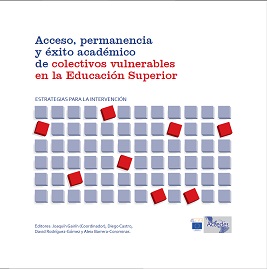
Available, in a single publication, the instruments and strategies created in the framework of ACCEDES project.
Enhancing and motivating equity in education is a social and university challenge. Unfortunately, Higher Education (HE) is still banned for certain disadvantaged groups, thus HE doesn’t fulfil its social purpose and doesn’t supply the real possibility for all citizens to participate. Having a fair HE system means giving opportunities of access, continuity and success without taking into account age, gender, ethnicity, residency, disability, socioeconomic background and other factors that can originate educational disadvantages.
From this point of view, inclusion and diversity are constituted as goals and challenges at the same time for HE system, its institutions and actors. The challenge is more obvious in the current knowledge society, which demands a system that favours development and consolidation of competencies, knowledge and abilities that make possible for students and graduates, as citizens, consolidate a critical and transformative participation of our society and the context where they are. Overcome it, requires to think of all people and to abandon barriers that used to be use with the purpose of homogenize students and make easier the management of the training process.
ACCEDES Project ACCEDES (DCI-ALA/2011/232), centred in “Academic access and success of vulnerable groups in risk contexts in Latin America” tackle the problematic mentioned before. Coordinated from the EDO Team (EDO: http://edo.uab.es/en), has directly involved 24 universities from 19 countries, and at the end, other universities has joint because of its relevance.
This contribution expects to be a synthesis of the project and its contributions, trying to give a general vision of the work developed and achieved, as well as to inform about the mechanisms that help to access to the knowledge developed. It is not just about to spread what has been done but also to encourage managers and university administrators and give them tools for improving their intervention processes.
Access to the complete publication: https://ddd.uab.cat/record/132954
Share on social media: