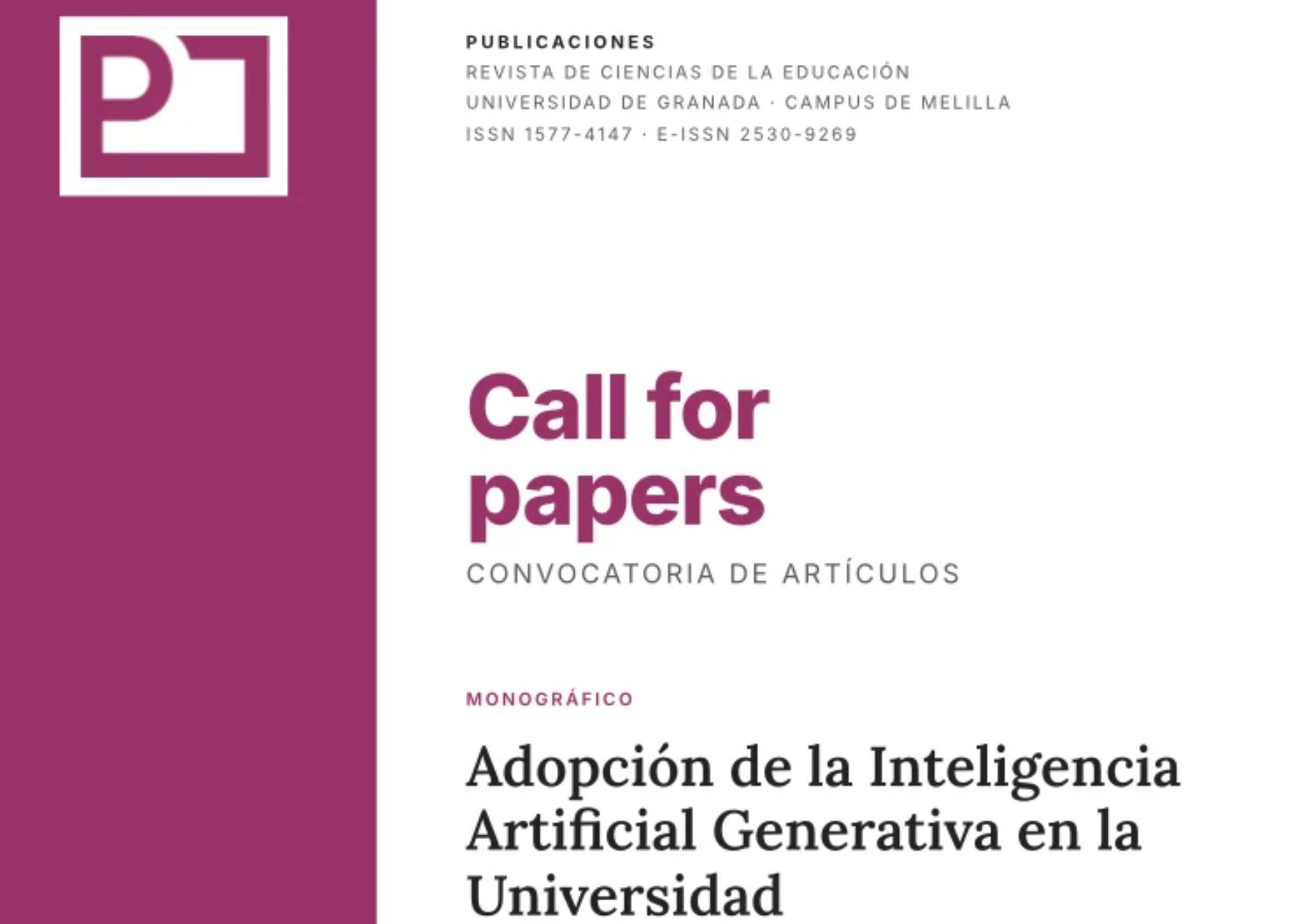
Aleix Barrera-Corominas, professor and researcher at CRiEDO, is co-editing the special issue Adoption of Generative Artificial Intelligence in Higher Education: Practices, Policies and Challenges, an initiative that invites the international academic community to submit contributions on the impact, regulation and integration of these technologies in higher education.
The call has been published by the scientific journal Publicaciones, edited by the University of Granada, and is coordinated by Juan Carlos de la Cruz Campos (University of Granada), Inmaculada Gómez-Jarabo (Complutense University of Madrid) and Aleix Barrera-Corominas (Autonomous University of Barcelona and CRiEDO).
The aim of this special issue is to deepen understanding of the real processes involved in adopting generative artificial intelligence in universities, analysing its educational, organisational and ethical implications. The initiative seeks to move beyond discussions of technological potential and provide evidence on how these tools are transforming teaching, learning, assessment, research and university management.
Priority topics include the uses and perceptions of generative AI among students and faculty, its integration into teaching and learning processes, the transformation of assessment systems, the development of digital competencies, faculty training, institutional policies, governance models and the ethical implications associated with its use.
The special issue is linked to the research project EdU-InA. Policies and Practices of Generative AI in Higher Education (PID2023-149069OA-I00), funded by the Spanish Ministry of Science, Innovation and Universities, the State Research Agency and FEDER funds. Aleix Barrera-Corominas serves as co-coordinator of the project together with Cristina Mercader, also a professor and researcher at CRiEDO.
The call welcomes research articles, theoretical studies and evidence-based innovative experiences. Manuscripts may be submitted until 15 January 2027, and publication of the special issue is scheduled for March-April 2027. All submissions will undergo external double-blind peer review.
Submit your contribution here.